Comparison
Remy hair vs virgin hair: what each label means and what to check
Remy is about which way the strands run; virgin is about what has been done to them. One bundle can be both, either or neither.
Published
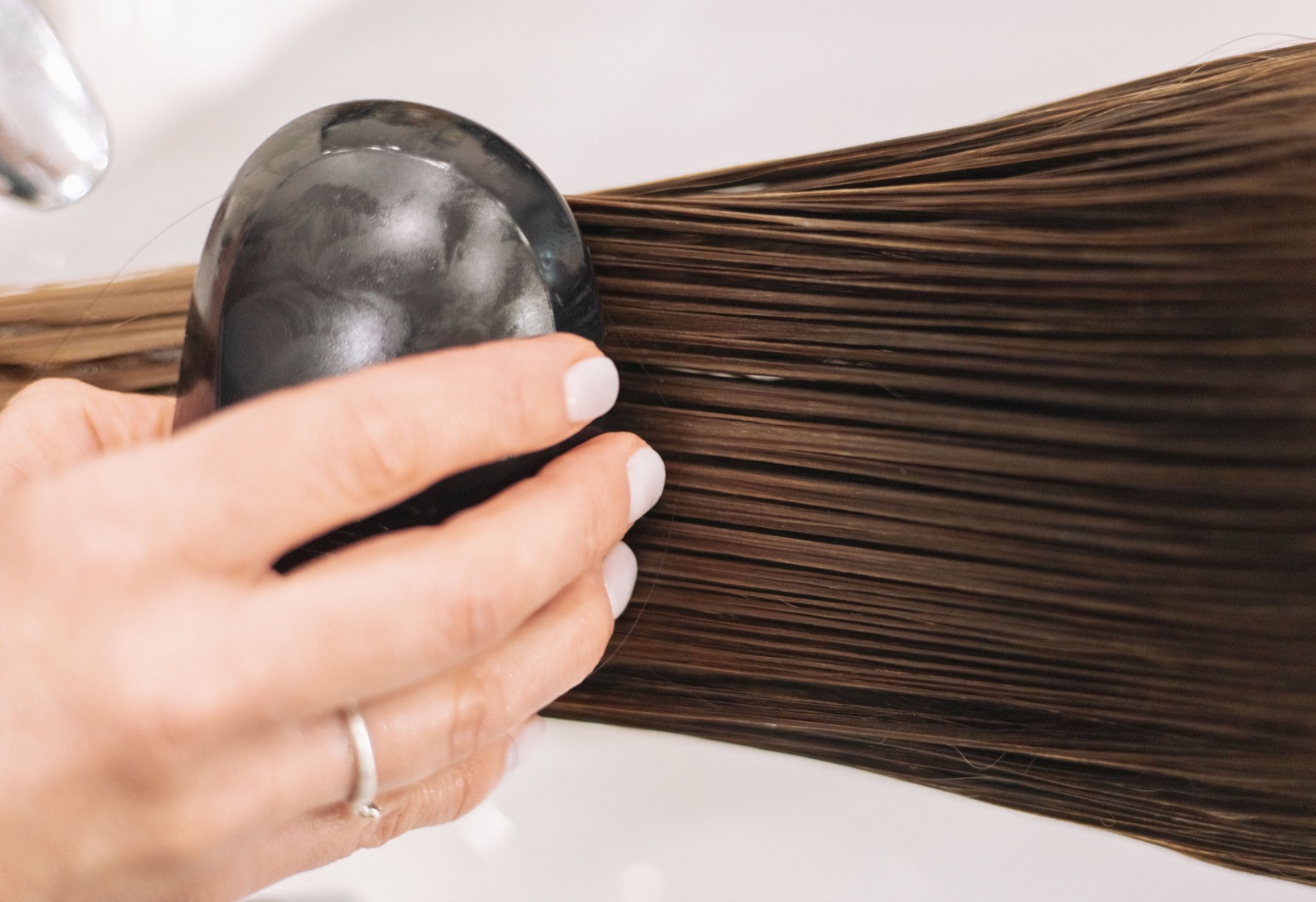
Remy hair and virgin hair answer two different questions. Remy hair is human hair collected so that every strand still runs root to tip in the same direction, with its cuticle kept. Virgin hair is human hair that has never been dyed, bleached, permed or relaxed. So "Remy vs virgin" is not a choice between two grades: a bundle can be Remy and virgin, Remy but colored, virgin but not aligned, or neither. The short answer: if you want hair you can color or lift yourself, look for virgin; if you want hair that tangles less over months of wear, look for Remy; for the longest wear, look for a listing that promises both. Neither word is a certified grade, which is the part most product pages leave out.
Remy vs virgin hair at a glance
| Remy hair | Virgin hair | Non-Remy hair | |
|---|---|---|---|
| What the label describes | Strand direction and cuticle | Chemical history | Strands not kept in one direction |
| Cuticle | Kept, all facing one way | Kept, never chemically lifted | Mixed directions; may be stripped and coated |
| Can it be colored before sale? | Yes, still Remy | No, or it is no longer virgin | Often chemically processed |
| Coloring at home | Usually takes color; results vary if it was pre-treated | Takes color best | Not reliable |
| Tangling | Low | Low if also aligned | Tangles and mats quickly |
| Wear life (Mayvenn's estimate) | Several months to a year | Up to a year or more with care | Weeks to a couple of months |
The wear-life row is one seller's comparison, not a test; how long any hair lasts depends on how it is washed, heated and stored.
What Remy hair means
Each human hair is covered in a cuticle, a layer of overlapping scales that all point from root to tip. Mayvenn compares cuticles that face opposite directions to Velcro: they catch on each other, and the hair tangles. Remy hair is collected so that every strand keeps its root end at the top of the bundle, and the cuticle stays on. The American Hair Loss Association describes Remy as human hair "kept in consistent root to tip orientation."
What Remy does not promise
The same association is direct about the limits: Remy "does not automatically mean virgin, unprocessed, European or superior quality," and it is "not a certified quality grade." Mayvenn adds that Remy hair that was dyed or relaxed on the donor's head is still Remy. So a "100% Remy human hair" listing tells you about direction, not about color, origin or how many times the hair has been processed.
Remy extensions and wigs
The word shows up across every format: Remy clip-in extensions, Remy tape-ins, Remy wefts for sew-ins and Remy wigs. In each case it means the same thing, aligned strands with the cuticle kept, and the same caveats apply. On a wig, the cap and lace usually matter as much as the hair label; the closure vs frontal comparison covers that side.
What virgin hair means
Virgin hair is human hair that "has never been dyed, bleached, permed, or chemically relaxed," in Mayvenn's words; the American Hair Loss Association's definition is the same in substance. Because its cuticle has never been chemically lifted, Mayvenn says virgin hair takes color better than any other grade, and its comparison puts virgin hair at up to a year or more with care.
When "virgin" is stretched
Christian Michael Hair Extensions, an extension seller, warns that "many brands use 'virgin' loosely," including on hair that has been processed. Colored hair is the clearest case. A 613 blonde bundle has been lightened, so strictly it is no longer untreated. Mayvenn, for example, sells its #27 and #613 blondes as virgin Indian hair that has been lifted, and says they can take deposit-only color or toner but shouldn't be bleached any further; its pre-colored shades, such as #1 jet black, shouldn't be dyed, lifted or bleached, while its natural black bundles have not been pre-colored and can be dyed or lifted. When you see "virgin" on a colored bundle, read it as "virgin before it was colored."
Does virgin also mean Remy?
Sellers disagree. Mayvenn says all virgin hair is Remy, though not all Remy hair is virgin. The American Hair Loss Association's definition of virgin covers only chemical history, and, as Christian Michael points out, some brands stretch the word. If alignment matters to you, look for both words in the listing.
Non-Remy hair and coated hair
Non-Remy hair is human hair collected without keeping the strands in one direction; Christian Michael notes that some companies mix hair from many donors. To stop mismatched cuticles from catching, the American Hair Loss Association says it "may be chemically processed to reduce or remove the cuticle," then "conditioned or coated to improve smoothness." Christian Michael describes the same practice as stripping cuticles and adding silicone, which can "look good at first but won't last." Once the coating washes out, Mayvenn's comparison says non-Remy hair "tangles and mats quickly." The association adds that this does not make every non-Remy product poor quality. It is usually the least expensive human hair, and it can be fine for a short-term look.

Why the labels can't be taken at face value
None of these words is a standard grade. The American Hair Loss Association says there is "no universal grading system that makes these labels directly comparable from one seller to another," and that origin names such as Brazilian or European "should not automatically be accepted as proof." It also notes that the country where a wig was made does not tell you where the hair came from. The same goes for grade numbers and words like raw: each seller defines them.
What to check before you buy
- Both words, spelled out. "100% human hair" alone says nothing about direction or processing. Look for Remy and virgin stated separately.
- The color. Natural black or natural brown can be virgin. Blonde, 613, burgundy and ombré have been colored, whatever the title says.
- Texture vs grade. Mayvenn points out that Yaki is a texture, not a grade; the same applies to body wave or kinky straight.
- Return policy. Since labels can't be verified at checkout, a seller's return terms for unopened bundles are your safety net.
- Ask the seller. Where the listing is vague, ask in writing whether the hair is cuticle-aligned and whether it has been colored or otherwise chemically processed.
Which to choose
If you plan to color or lift the hair
Choose virgin hair in a natural shade. It takes color best, and it has no previous processing to work around.
If you want low tangling over months
Choose Remy, ideally Remy virgin. Aligned cuticles are what keep wefts and extensions from matting.
If you want the hair to last across several installs
Virgin Remy is the usual choice for wefts you will take down and re-sew, as in a closure sew-in, or for a wig you plan to wear for a year.
If it is a one-off look on a budget
Remy that has been colored, or even non-Remy, can be enough for a few weeks. Expect more tangling as the coating wears off.
Whatever the label, care decides most of the wear life. Detangle from ends to roots, keep heat moderate and wash gently; the wig washing guide covers the routine for human hair units, and the hair guides section covers the rest of choosing hair.
Questions
What is the difference between Remy hair and virgin hair?
Remy hair is human hair collected so every strand runs root to tip in the same direction, with the cuticle kept. Virgin hair is human hair that has never been dyed, bleached, permed or relaxed. The first describes how the hair was collected, the second what has been done to it.
Is virgin hair always Remy?
Not by every definition. Mayvenn says all virgin hair is Remy, but the American Hair Loss Association defines virgin only by chemical history. If alignment matters to you, look for a listing that states both, and ask the seller if it doesn't.
Can Remy hair be dyed?
Yes. Remy only means the cuticles run in one direction, so hair that was colored or relaxed can still be sold as Remy. Mayvenn notes that virgin hair takes color best because its cuticle has never been chemically lifted.
Is Remy hair a certified grade?
No. The American Hair Loss Association says Remy is not a certified quality grade and that there is no universal grading system that makes seller labels comparable. Remy, virgin, raw and grade numbers are marketing terms set by each seller.
Can a 613 blonde bundle be virgin hair?
Only in the sense of where it started. 613 hair has been lightened, so it is no longer chemically untreated; when a seller calls a 613 bundle virgin, it means the hair was virgin before it was colored.
Sources
- American Hair Loss Association — Hair types used in hair replacement
- Mayvenn — Virgin vs. Remy vs. Yaki hair: what's the difference?
- Christian Michael Hair Extensions — Reading between the lines: extension marketing claims vs. reality
- Mayvenn — Virgin Indian straight bundle (product page)
Read next
Human hair bundles: wefts, textures, lengths and how many you need
What a bundle actually is, what the labels on it mean, and how many you need for the length you want.
Human hair wigs: how to choose the hair, cap, texture, density and length
What to check in a human hair wig listing before you pay: the hair itself, the cap, the texture, the density and the size.
Hair color codes explained: 1B, 99J hair color, 27, 30, 613 and ombré
The numbers on wigs, bundles and extensions, the letters and slashes that combine them, and why the same code can look different from one brand to the next.