Guide
Bead loom for beginners: warping, seed bead sizes, patterns and finishing
Which loom and beads to start with, how to set the warp, how to weave each row from a pattern, and how to finish the ends so nothing unravels.
Published
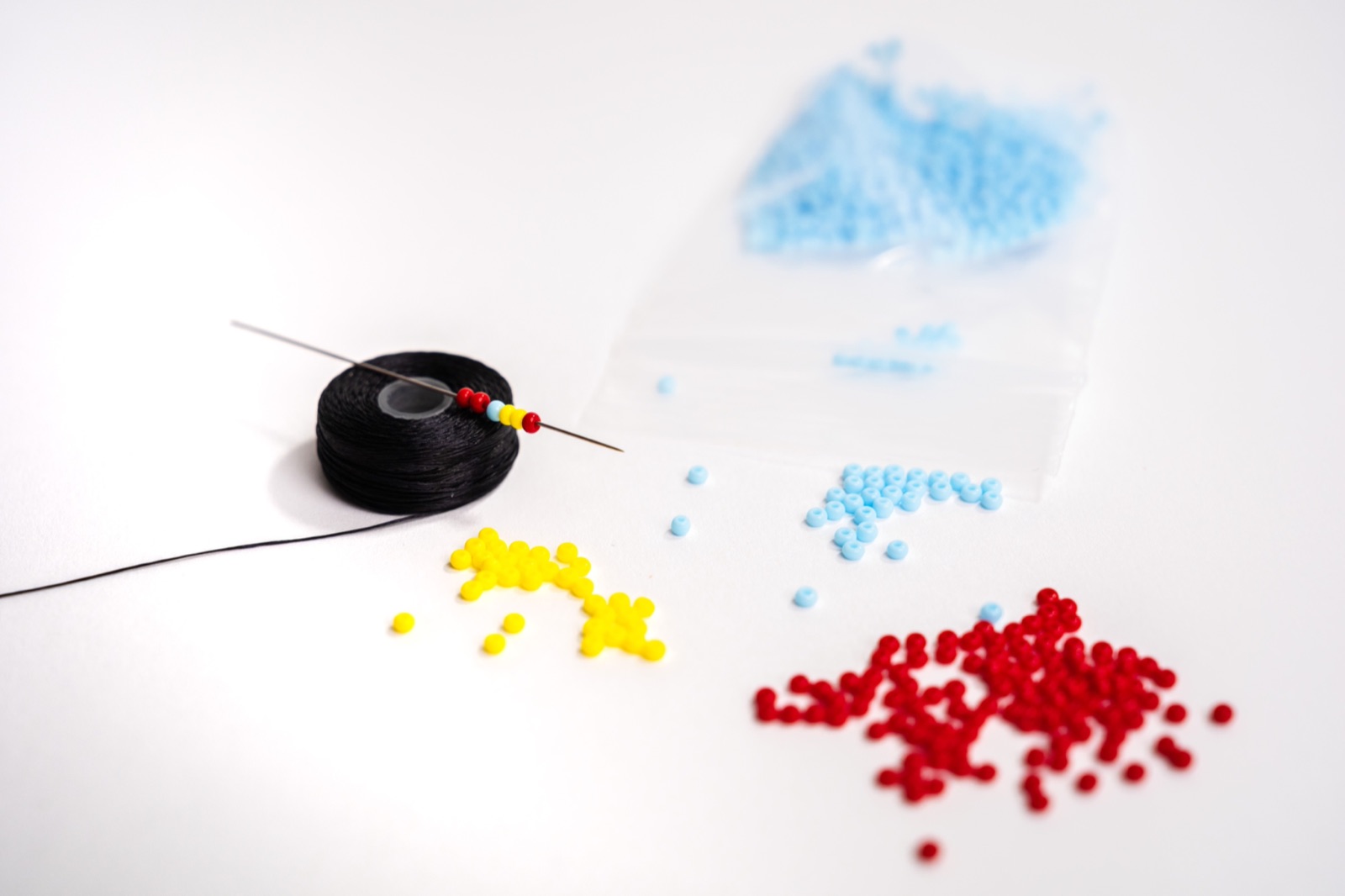
A bead loom weaves seed beads into a flat, solid band, the kind used for bracelets, hatbands and pieces of jewelry with a picture or a geometric design in them. This guide covers what a beginner needs to pick for a first bead loom, how seed bead sizes work, how to warp the loom, how to weave a row and read a loom bead pattern, and how to finish the warp ends so the piece holds together.
What you'll need
Essentials
-
Bead loom
: holds the warp threads under tension and spaced one bead apart with grooves, a comb or a spring. -
Seed beads
: small, even beads, often size 11/0, in the colors your pattern calls for. -
Beading thread
: a strong nylon or braided thread for the warp and the weft, sized to pass through each bead twice. -
Long beading needle
: long enough to hold a full row of beads with room for the tip and the eye. -
Sharp scissors
: clean cuts on the warp and weft tails.
Optional
-
Bead pattern or seed bead graph paper
: a grid with one cell per bead, so you can follow or draw a design row by row. -
Ruler and clear tape
: to measure the piece as it grows and to keep the cut warp ends tidy until you finish them.
How a bead loom works
Loom beadwork uses the same two sets of threads as any weaving. The warp threads run lengthwise and go on the loom first, held under tension. The weft thread runs crosswise and carries the beads.
Each row takes two passes of the weft. You string a full row of beads, press them up between the warp threads from underneath so that one bead sits in each gap, then run the needle back through the same beads above the warp. The warp ends up sandwiched between the two passes and the beads are locked in place. Most loomed pieces are rectangles, though it is possible to increase and decrease to make angled or curved shapes.
Choosing a bead loom
Fire Mountain Gems sorts looms into two groups. A beading loom is the compact kind it recommends for beginners, made for seed bead designs up to about 10 inches. A larger weaving loom handles designs from about 22 to 40 inches.
What to compare
- Frame: plastic, wood or metal. A wooden bead loom and a metal one both work; what matters is that the frame does not flex when the warp is tight.
- Number of slots: the slots, comb or spring set the most warp threads the loom can hold, and so the widest piece. The small looms in Fire Mountain Gems' comparison chart have from 25 to 45 slots.
- Adjustable length: some looms, such as the Versa-Loom and the Clover loom, adjust in length.
- Roller bars: these wind the finished beadwork out of the way, so the piece can be longer than the loom.
- Spacing: the grooves or spring keep the warp threads one bead-width apart, so check which bead size a loom is spaced for. Fire Mountain Gems' Mirrix tutorial uses a 14-per-inch spring for size 11 seed beads, since about 14 of them fit in an inch.
Heddle bead looms, which raise every other warp thread so the beads slide into the gap, were popular in the United States around the start of the 20th century and a few are still made. This guide covers the frame-style loom and the two-pass method described above.
Bead loom kits and DIY looms
A bead loom kit usually includes instructions, a stitch chart, beads, thread and sometimes a pin back. You still need scissors, a ruler, tape and a beading needle. A beading loom DIY version can be as simple as a foam tray with notched slits to hold the warp, which is enough to learn the stitch before you buy a loom.
Seed bead sizes for loom work
Seed beads are sized in "aught": 11/0 is spoken "eleven aught" and usually just called size 11. The higher the number, the smaller the bead.
| Size | Approximate diameter | Notes |
|---|---|---|
| 6/0 | 4.0–4.3 mm | the largest common size, chunky rows |
| 8/0 | 2.5–3.1 mm | bigger beads, fewer per inch |
| 11/0 | 1.8–2.1 mm | a common size for detailed loom patterns |
| 15/0 | 1.3–1.4 mm | very fine detail, small pieces such as earrings |
Sizes vary between makers, and the difference between two brands can be bigger than the difference within one size. Buy all the beads for one piece from the same brand and size so the rows line up.
Two shapes matter on a loom:
- Round seed beads (rocailles) are rounded, donut-shaped beads.
- Cylinder beads, such as Miyuki Delicas, have flat ends, thin walls and large holes. They sit squarely next to each other, so rows and columns come out straighter and the surface smoother. Delicas are made in 15/0, 11/0, 10/0 and 8/0.
Japanese seed beads are generally more uniform in size and shape than Czech beads, with larger holes for their size, which helps when the needle passes through each bead twice.

Thread for the warp and weft
Fire Mountain Gems calls size D Nymo and FireLine the most versatile warp threads: strong, and still flexible in the finished piece. For small pieces such as earrings or necklaces in size 11 or 15 beads, it suggests the lighter size B Nymo; for size 11 or larger beads in a bracelet or hatband that will see wear, size D. Whatever you choose, the thread has to pass through every bead twice, so match it to the bead holes.
How to warp a bead loom
- Count the warp threads. You need one more warp thread than the number of beads in the widest row. A pattern 10 beads wide takes 11 warps.
- Tie on. Tie the end of the thread securely to the loom's warp bar or peg, as your loom's instructions show.
- String the warp. Lay each thread through its own slot or spring space, so the threads run parallel and one bead-width apart.
- Set the tension. Tighten the warp until none of the threads is baggy or loose. If a thread is slack, the needle can slip behind it while you weave.
How to weave a row
- Cut the weft. Fire Mountain Gems' Mirrix tutorial starts with a piece of thread about 4 feet long on a beading needle.
- Attach it. Tie the weft to an outside warp thread, leaving a long tail you will weave in later.
- Pick up the row. Thread the beads for the first row onto the needle in pattern order.
- Press them up. Pass the thread under the warp, then hold the beads from underneath with a finger and push them up so one bead sits between each pair of warp threads.
- Lock them. Run the needle back through the same beads, this time keeping it above the warp threads.
- Repeat. Push each new row snug against the one before.
When about 6 inches of thread is left, stop and start a new length.
Reading a loom bead pattern
A loom bead pattern is a grid. Each cell is one bead, each row of cells is one row of weaving, and the number of cells across is your bead count per row (add one for the warp count).
- Start at one end and mark off each row as you finish it.
- Read every row from the same side. Fire Mountain Gems' rule is to follow the pattern in the same direction on every row, either right to left or left to right, and to string the beads in that order.
- Pre-sort colors into separate dishes before you start a section.
To draw your own designs, print seed bead graph paper and color one cell per bead.

Finishing warp ends
Finishing off the warp threads is often called the hardest part of loomwork. Work slowly here.
- Close the weaving. After the last bead row, weave the working thread back and forth, over and under the warp threads, for about 1/4 inch. Re-thread the starting tail and do the same at the other end.
- Let it rest. Loom beadwork shrinks a little once tension comes off. Let it rest before you tie the ends, so the piece does not pucker.
- Cut it free. Clip the warp threads in the center of the unwoven section so each end of the beadwork keeps long tails to work with.
- Weave the tails in. Thread each tail on a needle and work it back into the beadwork: pass behind a bead, under the last weft row and the neighboring warp, and back up between beads.
- Knot it. Pull the thread until a small loop forms, pass the needle through the loop and pull the knot tight. Run through a few more beads and add a second knot in another spot.
- Trim. Cut each tail between two beads, so you do not snip a warp or weft thread on the outside edge.
After the ends are secure, add the closure the project calls for, such as a clasp or a beaded loop and button.
Common beginner mistakes
- One warp too few. Count beads across, then add one.
- Weaving with the needle below the warp on the return pass. The second pass must go above the warp, or the row is not locked.
- Mixing bead brands mid-piece. Different makers' 11/0s are not the same size.
- Warp too loose. A baggy warp thread lets the needle slip behind it, so the bead is not locked in.
- Cutting the warp too short. Leave long tails; they are what you weave back in.
Bead looms share their logic with every other loom in the loom weaving section. The potholder loom is the quickest way to feel warp and weft in your hands, and weaving yarn explains thread sizes if you go on to weave cloth.
Questions
How many warp threads do I need on a bead loom?
One more warp thread than the number of beads in a row. A pattern ten beads wide needs eleven warp threads, so every bead sits between two of them.
What size seed beads should a beginner use on a bead loom?
Size 11/0 is a common choice: Fire Mountain Gems pairs it with size D thread for bracelets and hatbands, and its Mirrix tutorial uses a spring spaced for 11/0 beads. Cylinder beads in 11/0 give even straighter rows.
What thread is best for bead loom warp?
Fire Mountain Gems names size D Nymo and FireLine as the most versatile warp threads, strong while keeping the piece flexible. It suggests the lighter size B Nymo for smaller pieces such as earrings in 11/0 or 15/0 beads.
Can I use an adjustable bead loom for long pieces?
Yes. Some looms adjust in length, and others have roller bars that wind the finished beadwork out of the way so the piece can be longer than the loom itself.
Why does my loom beadwork pucker after I take it off?
The warp is stretched on the loom, so the piece comes off slightly smaller. Fire Mountain Gems' Mirrix tutorial says to let it rest before you tie off the warp ends, to avoid puckering.
Sources
- Fire Mountain Gems — Beginner's guide to loomwork
- Fire Mountain Gems — How to set up a beading loom
- Fire Mountain Gems — How to weave beads on a Mirrix loom
- Fire Mountain Gems — What kind or size of thread do I use on the beading loom?
- Artbeads — How to finish bead looming thread
- Wikipedia — Bead weaving
- Wikipedia — Seed bead
Read next
Weaving loom for beginners: how to choose your first loom
Frame, peg, rigid heddle, inkle or table loom: what each one weaves, what comes in the box and how to pick the one you will actually use.
Potholder loom: how to weave a loop potholder and bind off the edge
Loom sizes, cotton loops, the over-under rows and the chained edge that holds a woven potholder together.
Weaving yarn: how to choose warp and weft yarn, from 8/2 cotton to wool
Warp and weft ask different things of a yarn. Here is how to read weaving yarn counts and pick yarn that suits your loom and project.