Buying guide
Half wigs, U part and V part wigs: how they differ and how to choose one
All three let your own hair do part of the work. The difference is how much of it you leave out, and that decides blending, upkeep and protection.
Published
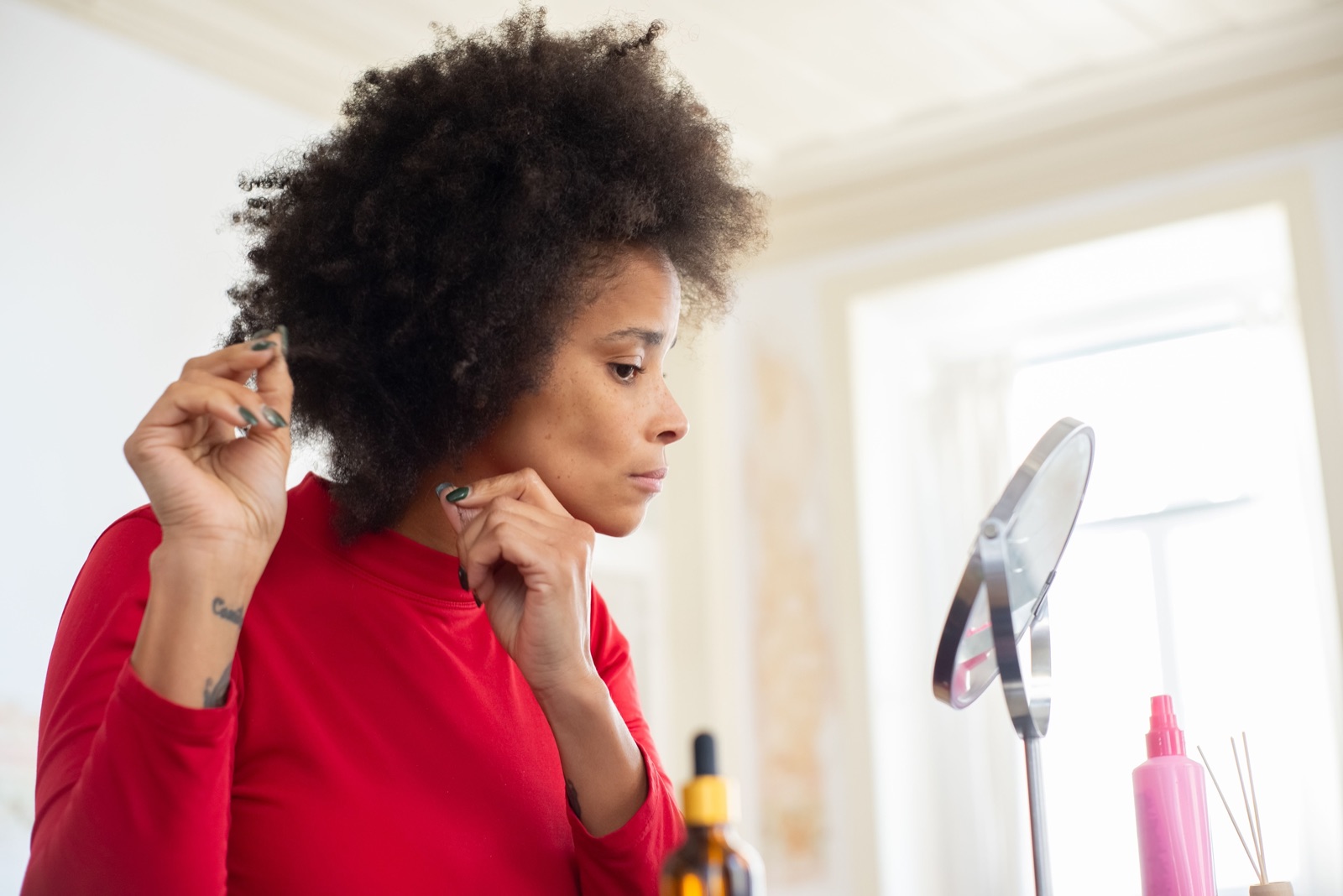
Half wigs, U part wigs and V part wigs, in human hair or synthetic, are partial wigs: they cover most of your head while some of your own hair stays out and blends with the wig. None of them has lace or needs glue; they clip on with combs and a band or drawstring. The difference is how much of your hair you leave out. A half wig leaves out the whole front hairline, a U part leaves out a strip along the part, and a V part leaves out very little or nothing. This guide compares the three, then covers matching the texture, sizing, putting one on and looking after your leave-out.
Half wig vs U part vs V part at a glance
| Half wig | U part wig | V part wig | |
|---|---|---|---|
| What shows of your hair | The front hairline, ear to ear | A strip along the part | A small amount at the part, or none |
| Opening | Cap starts behind your hairline | U-shaped, about 4 inches long (UNice) | Narrow V |
| Attaches with | Combs or clips at the front, drawstring at the back | 3 combs, snap clips and a strap (UNice) | 4 combs and a drawstring (UNice) |
| Leave-out to blend | Most | Moderate | Least |
| Covers thinning at the part | No | No | Yes, in no-leave-out versions |
| Daily styling | Blend the front | Blend the part | Little or none |
The amount of leave-out works the same way it does on a sew-in: the more you leave out, the better the blend and the more of your own hair is exposed to styling. The leave-out vs no leave-out comparison covers that trade-off for weaves.
Half wigs in human hair and synthetic
Hermosa Hair describes a half wig (or three-quarter wig) as made to cover about three quarters of the head, so your own hair at the front stays out. It attaches with a comb or clips at the front and a drawstring at the back, and some have an extra hook for adjusting the fit. Your leave-out is the section across the front from ear to ear, combed back over the wig's edge.
Headband wigs are a close relative. Nadula calls them half wigs too: the cap sits across the top of the head rather than reaching the forehead, and the front is either your own hair or a fabric band.
Who a half wig suits
People with enough healthy hair at the front to blend, who want a quick install with a natural hairline. Hermosa says half wigs are easier to install than frontal wigs or sew-ins.

U part wigs
A U part wig is a full cap with a U-shaped opening at the top. UNice gives the opening as about 4 inches long; you pull a strip of your own hair through it to form the part and blend over the wig hair. To install one, UNice says you cut the band across the cap and press the snap clips and combs into your braids; CurlyMe notes that two straps at the top of the cap are cut off before wearing. UNice says a U part usually costs slightly less than a V part with the same specifications.
Who a U part suits
People with healthy hair at the crown and part who want a natural-looking part and don't mind blending it each day. CurlyMe says the U part needs more upkeep, because your natural hair has to be blended.
V part wigs
A V part wig has a narrow V-shaped opening instead of a U. UNice says it needs up to three quarters less leave-out than a U part, has no band to remove, and sits on with four combs inside the opening. CurlyMe says you can leave a little hair out in the opening or choose a "no leave out" version, and recommends the V part for people with thin or sparse hair who want a defined part without blending their own hair.
Who a V part suits
People with fine or thinning hair at the part, anyone who wants to keep most of their hair covered and protected, and anyone who would rather not heat-style a leave-out.
Matching the texture to your leave-out
With any of the three, your own hair sits right next to the wig hair, so texture matters more than with a full wig. Hermosa says to choose a half wig with a texture close to your natural hair and notes that type 4 hair pairs best with a type 4 extension.
Kinky curly and kinky straight half wigs
These are the textures made to blend with natural hair without daily heat.
Kinky curly
A kinky curly half wig or curly U part wig matches coily, type 4 leave-out worn in its natural pattern.
Kinky straight
A kinky straight half wig usually matches natural hair that has been blown out or stretched, with a little texture left in it.
Straight and body wave
A straighter wig means straightening your leave-out to match. UNice says to smooth, curl or flat-iron the front to match the wig; Hermosa recommends a heat protectant before any heat styling. Daily heat on the same section of hair is the main cost of a straight U part or half wig, so if you wear one often, a texture closer to your own saves your leave-out.
What else to check before buying
Cap size
Measure around your head from the center of your forehead, behind one ear, around the nape and back. Headcovers' chart puts petite at 20 to 21.5 inches, average at 21.5 to 22.5 inches and large at 22.5 inches and up. If you are between sizes, choose the larger: the straps or drawstring can take it in.
Combs, clips and drawstring
Look for combs at the front and sides and a drawstring or adjustable straps at the back; more anchor points mean a steadier fit. A wig grip adds hold if the clips have little hair to grip.
Human half wigs vs synthetic
Human hair half wigs and U parts take heat, so you can style the wig and your leave-out together. Synthetic versions cost less, but if your leave-out needs a flat iron to match, the wig hair has to stay away from that heat.
How to put on a half wig
Hermosa's steps, in order:
- Part off the leave-out, the smaller section across the front from ear to ear, and hold it with a tie, claw clip or loose twist.
- Braid the rest into cornrows or flatten it under a wig cap. Decide where your part will be.
- Adjust the drawstring so the wig fits the section it will cover.
- Set the comb or clips at the front of the braided section, secure the sides, then tighten the drawstring at the back and adjust the hook if there is one.
- Moisturize and style the leave-out, then blend it over the wig.
For a U or V part the order is the same, except your leave-out is the strip at the part and the wig's combs go into the braids around it.
Protecting your leave-out
UNice's care advice for U and V parts: don't braid the leave-out tightly, give your scalp rest between installs, detangle from the ends with a wide-tooth comb, wash the wig with a sulfate-free shampoo every 7 to 10 wears, air-dry it on a stand, and take it off to sleep, which UNice calls gentler on your hair (if you keep it on, wrap it in silk or satin). The wig washing guide covers the wash.
The American Academy of Dermatology warns that styles which pull on the hair can lead to traction alopecia, and that pain means a style is too tight. Keep the clips and combs snug but painless and move them if they pull. If you notice thinning at your part or hairline, see a dermatologist.
More guides on choosing hair are in the hair guides section.
Questions
What is a half wig?
A half wig is a partial wig that covers the back and top of your head while your own hair at the front stays out and blends over its edge. It attaches with combs or clips at the front and a drawstring at the back, with no lace and no glue.
What is the difference between a U part and a V part wig?
A U part wig has a U-shaped opening at the top, about 4 inches long on UNice's units, filled by a strip of your own leave-out hair. A V part wig has a narrower V-shaped opening that needs much less leave-out, and some V parts are made to be worn with none.
Which is better for thin hair, a U part or a V part wig?
A V part wig is usually the better fit, because it needs little or no leave-out and keeps most of your hair under the cap. A U part needs enough of your own hair at the part to cover the opening.
Do you need to match your hair texture to a half wig?
Yes. Your leave-out sits right next to the wig hair, so choose a texture close to your own: kinky straight or kinky curly for type 4 hair, or straighten or curl your leave-out to match a straighter wig.
Can you wear a U part wig in a ponytail?
Sometimes, if your own hair is long enough to be gathered with the wig hair at the front and sides. Hermosa Hair suggests a round three-quarter part on a half wig when you plan to wear it in a ponytail.
Do half wigs and U part wigs damage your hair?
They can if the clips pull or the leave-out gets heat every day. Keep the clips snug but painless, use a heat protectant, don't braid the leave-out tightly and give your scalp breaks between installs; see a dermatologist if you notice thinning.
Sources
- Hermosa Hair — How to install a half wig
- UNice — V part wig vs U part wig
- CurlyMe — U part vs V part wig: how to choose
- Nadula — What is a headband wig and how to wear it
- Headcovers.com — Wig size guide: how to measure your head
- American Academy of Dermatology — Hairstyles that pull can cause hair loss
Read next
Glueless wigs: how they stay on and how to choose one
Bands, combs and a cap that fits do the work glue would: how each type of glueless wig holds, and what to check before you buy one.
Sew-in with leave-out vs no leave-out: leave-out, closure or frontal
How a leave-out, a closure and a frontal compare on blending, heat, parting and upkeep, and who each one suits.
Ponytail extensions and the frontal ponytail: drawstring, wrap-around and claw clip
Which attachment holds which ponytail, how to match the hair to yours, and what a frontal ponytail takes.