Guide
Warp and weft in weaving: what they are and how to tell them apart
The two sets of threads every woven piece is made of, the words weavers use for them, and why the warp needs a stronger yarn.
Published
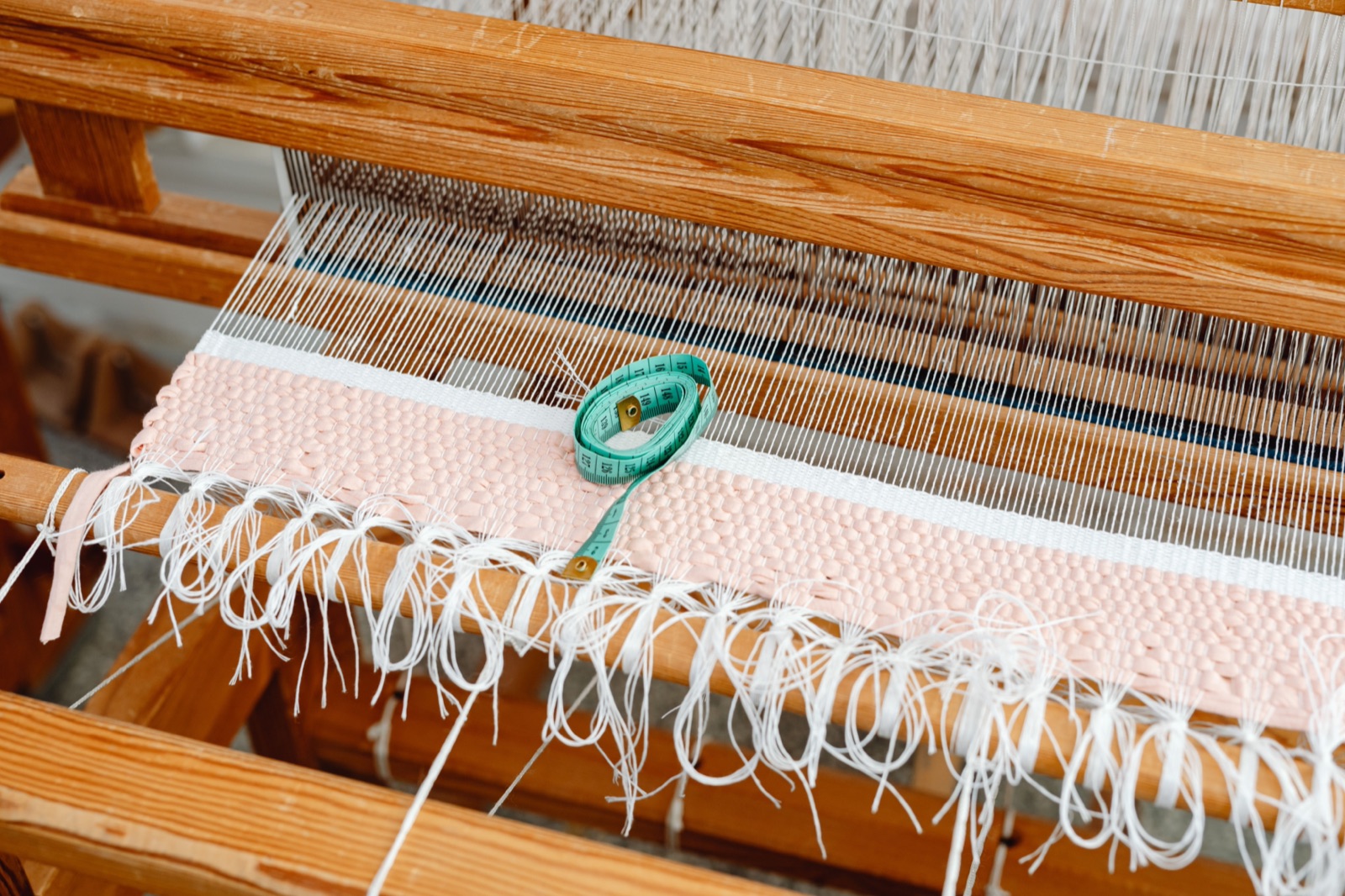
Warp and weft in weaving are the two sets of threads every woven piece is made of. The warp is held lengthwise under tension on the loom; the weft is passed across it, over and under, from side to side. Everything else in weaving (the loom, the shuttle, the pattern) exists to keep the warp in order while the weft goes in. This guide explains both, the words weavers use for them, why they need different yarns, and how to tell them apart in a finished cloth.
Warp and weft in weaving: the basics
The warp is the set of threads stretched on the loom before you start. On the loom they run up and down; in the finished cloth they run lengthwise, parallel to the side edges. The loom's whole job is to hold the warp under tension.
The weft is the yarn that travels side to side, at right angles to the warp. It is carried across on a shuttle or a needle and is also called the fill or filling. The weft is not under tension while you weave; it lies in the warp and is pressed into place.
The words are old. Weft comes from the Old English wefan, to weave. Warp comes from the Old English wearp, from a verb meaning to throw: the warp is what the weft is thrown across.

Ends and picks
Weavers give single threads their own names:
- An end is one warp thread.
- A pick is one pass of weft across the warp.
They also count them:
- EPI, ends per inch: how many warp threads sit side by side in an inch.
- PPI, picks per inch: how many rows of weft there are in an inch of cloth.
Sett
The sett is the spacing of the warp, usually given as ends per inch. On a frame loom the teeth or notches set it: Schacht's Lilli Loom has teeth at 6 ends per inch, which you can double to 12. On a rigid heddle loom the reed sets it; Ashford makes reeds from 2.5 to 15 dents per inch. A thicker yarn needs a lower sett, a finer one a higher sett.
How warp and weft interlace
The shed
To weave, you need an opening in the warp for the weft to go through. That opening is the shed: some warp threads are raised and others lowered, and the weft passes between them. On a floor or table loom the shafts make it; on a rigid heddle loom the heddle; on a simple frame loom a shed stick or your fingers. After each pick the shed changes, so the next pick goes over the threads the last one went under.
Plain weave
The simplest structure is plain weave, also called tabby: the weft goes over one warp, under the next, all the way across, and on the next row the other way round. Every other structure, from twill to tapestry, is a variation on which warps the weft goes over and under.
Balanced, warp-faced and weft-faced
The ratio of warp to weft changes how the cloth looks:
- Balanced weave: the same number of picks per inch as ends per inch. You see warp and weft about equally.
- Warp-faced: the warp is set close together and the weft spaced widely, so the warp covers the surface. Bands woven on an inkle loom or with tablet weaving cards are often warp-faced. All the color and pattern has to be planned in the warp before you start.
- Weft-faced: the warp is spread apart and the weft beaten closely, so the weft hides the warp. Tapestry is the main example.

Warp and weft threads: why they need different yarns
The warp has to be strong
The warp is under tension for the whole time you weave, and on most looms it also passes through heddles and a reed that move with every row. It needs to be strong and smooth, and warp yarn is usually spun and plied. Traditional warp fibers include wool, linen, alpaca and silk; cotton became strong enough for machine weaving only with better spinning in the Industrial Revolution.
For hand weaving at home, cotton is the usual choice. Schacht's frame loom projects use 12/6 cotton seine twine, and Ashford sells a strong unbleached 100% cotton 12/6 thread as tapestry loom warp.
The weft can be almost anything
The weft carries almost no tension, so it does not need to be strong. That is where the color, texture and softness of a piece usually come from: wool, cotton, linen, fabric strips, thick novelty yarns. In a weft-faced piece the weft is all you see; in a balanced cloth it shares the surface with the warp.
Matching the warp to the sett
The warp yarn also has to suit the spacing. Rebecca Mezoff, writing for Schacht, uses a thicker warp for a lower sett and a thinner one for a higher sett; her tapestry example is 12/6 or 12/9 cotton seine twine at 8 ends per inch.
What happens to warp and weft as you weave
- Take-up: the warp gets slightly shorter as you weave, because the weft makes it bend over and under. Plan a little extra warp length for it.
- Draw-in: the cloth narrows at the edges if each pick has too little weft in it. Schacht calls a little draw-in, about 1/4 to 1/2 inch, natural on a loom with a reed; more than that strains the edge warps. Laying the weft in the shed at about 45 degrees, or in small hills, gives it the extra length it needs.
- Selvedges: the side edges of the cloth, formed where the weft turns around the outermost warp. They run parallel to the warp.
- Heading and fringe: the first rows, often woven in waste yarn, are the heading. The unwoven warp left on the loom after the cloth comes off is called thrums; warp ends left on the cloth can become a fringe.
How to tell warp from weft in fabric
- Find the selvedge. The finished edge that does not fray is a selvedge. The warp runs parallel to it.
- Look at the fringe. On a handwoven scarf or rug, the fringe at the ends is usually warp.
- Check which threads show. In a band from an inkle loom, mostly warp; in a tapestry or a frame loom wall hanging, mostly weft.
Warp and weft on different looms
| Loom | Where the warp is | How the weft goes in |
|---|---|---|
| Frame loom | Wound around the frame, top to bottom | Needle or stick shuttle, shed made by hand or a stick |
| Peg loom | Threaded through the pegs, trailing behind the board | Woven around the pegs, then slid down onto the warp |
| Rigid heddle loom | Through the slots and holes of the heddle, wound onto the warp beam | Shuttle through the shed made by lifting or lowering the heddle |
| Inkle loom | Wound around the loom for a narrow band | Passed through by hand; the warp shows on the surface |
| Table or floor loom | Through heddles on 4, 8 or more shafts and through the reed | Shuttle through the shed opened by the shafts |
For a first loom to try this on, see weaving loom for beginners or the peg loom guide, and start at loom weaving for the rest of the section.
Questions
What is the difference between warp and weft?
The warp is the set of threads held lengthwise under tension on the loom; the weft is the thread passed across them, over and under, from side to side. In finished cloth the warp runs parallel to the finished side edges, the selvedges.
Which is stronger, warp or weft?
The warp has to be. It is held under tension for the whole time you weave and is rubbed by the heddle or reed, while the weft carries almost no tension. That is why warp yarns are smooth, strong and usually plied.
What are warp and weft threads called individually?
A single warp thread is an end, and a single pass of weft across the warp is a pick. Weavers count ends per inch (EPI) for the warp and picks per inch (PPI) for the weft.
What is warp and weft in simple terms?
Warp is the threads that go up and down on the loom and stay put; weft is the thread that goes back and forth through them. Weave the weft over one warp and under the next and you have plain weave, the simplest cloth.
How can I tell the warp from the weft in a piece of fabric?
Find a selvedge, the finished edge that does not fray: the warp runs parallel to it and the weft runs across it. In a warp-faced band you mostly see warp; in a tapestry you mostly see weft.
Sources
- Wikipedia — Warp and weft
- U.S. National Park Service — Glossary of weaving terms
- Jane Stafford Textiles — What do those terms mean?
- Schacht Spindle Company — Weaving terms
- Schacht Spindle Company — Lilli Loom assembly and weaving instructions
- Schacht Spindle Company — Taming draw-in for better selvedges
- Schacht Spindle Company — Rebecca Mezoff, Warping frame looms for different setts
- Ashford — Rigid heddle looms brochure (reeds and tapestry warp thread)
- Handwoven — Types of weaving looms
Read next
Weaving yarn: how to choose warp and weft yarn, from 8/2 cotton to wool
Warp and weft ask different things of a yarn. Here is how to read weaving yarn counts and pick yarn that suits your loom and project.
Wooden loom for weaving: how to warp and weave on a frame loom
From an empty frame to a finished wall hanging: warping, spacing, the first rows, keeping the edges straight and finishing.
Weaving loom for beginners: how to choose your first loom
Frame, peg, rigid heddle, inkle or table loom: what each one weaves, what comes in the box and how to pick the one you will actually use.